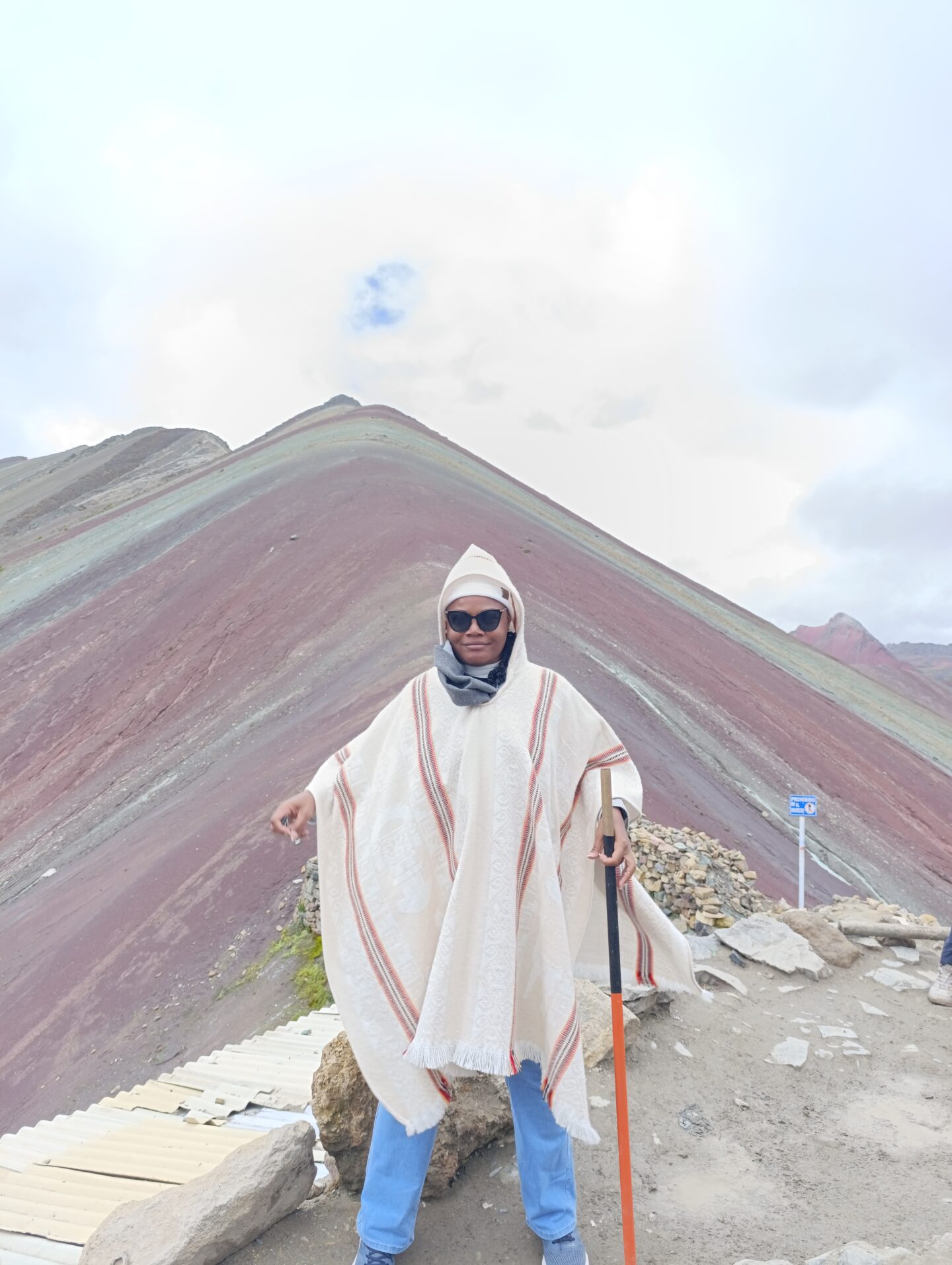
I almost didn’t make it up Rainbow Mountain.
Not because of the altitude, though, that almost got me too. It was the first stretch from the bus to where the horses were tied up, maybe fifty metres of slow uphill walking, and somewhere in that fifty metres, I realised my lungs had stopped cooperating. That was the moment it hit me, oh, this is why they put the horses right here. I’m not chancing it. I need a horse.
Nothing had prepared me for how I felt at that moment. I’d been in Cusco for three days, and let’s not forget I’d lived in Quito for three years before that high altitude, Andes, all of it. I’d also taken a few tablets that morning, drunk some coca tea, and prepared every trick a friend in Cusco had given me. And still fifty metres in, I knew I needed help.
So we bargained with a lady and climbed onto a horse. Then I let her carry me up the mountain. Later, though, I walked back down on my own legs because something in me needed to know I could. I arrived back on the bus with the worst headache of my life, a quiet kind of pride I hadn’t felt in a while, and a story I’ve been telling friends ever since.
This guide is also everything I learned along the way, what to book, what to budget, how to handle the altitude, and which of the three ways up the mountain might be right for you. I’m telling it the way I’d tell a friend who was thinking about going. Pull up a seat.
I came home with the worst headache of my life, a quiet kind of pride I hadn’t felt in a while, and a story I’ve been telling friends ever since.
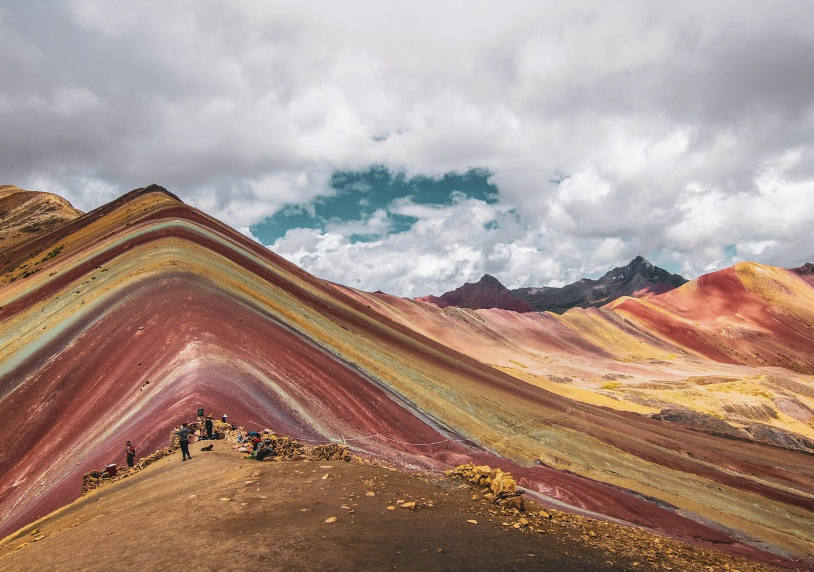
| Where it is: Cordillera de Vilcanota, southern Peru, about 3 hours by road from Cusco How high: 5,200 metres (17,000 feet) at the summit How to visit: Day tour from Cusco, picked up between 3 and 4 am, back by 5 pm What it costs: $30–$80 USD per person for the tour, plus 30 PEN entry, plus 80–100 PEN if you take a horse Best time to go: May to September (dry season). Skip if: You have heart conditions, you’re pregnant, or you’ve been in Cusco for less than 48 hours |
Where Rainbow Mountain Actually Is?
The drive from Cusco takes about three hours. ai fell asleep for the first hour because the bus picked us up at four in the morning. I woke up somewhere in the second hour when the road starts climbing in earnest, and that’s when I realised where I was.
Rainbow Mountain sits in the Cordillera de Vilcanota, a stretch of southern Peru about a hundred kilometres south-east of Cusco city. The trailhead, the actual point where you get off the bus and start walking, is at 4,600 metres. The summit, where the colours are clearest, is at 5,200 metres. For context, that’s nearly 1,800 metres higher than Cusco itself and almost 3,000 metres higher than Machu Picchu, which many consider the highest point, but it isn’t. Not by half.
Our guide on the way up the mountain told us, with that pride locals have when they’re sharing their place with you, that we shouldn’t really be calling it Rainbow Mountain at all. That’s just what tourists call it. The actual name in Quechua is Vinicunca, which means seven-coloured mountain. He said it the way you’d say a name your grandmother gave you. I started using it for the rest of the trip, and the difference in how locals respond when you do even just trying was something I wasn’t expecting.
The mountain itself sits on the ancestral lands of the area’s Quechua communities. They manage tourism access, they collect the entrance fee at the trailhead, and they own the horses you’ll see tied up at the bottom. The 30 PEN you pay for entry goes directly to them. It’s worth knowing. These are the people whose grandparents farmed this valley long before anyone called it Rainbow Mountain or built a single trailhead bathroom. They’re the reason any of this exists for tourists at all.
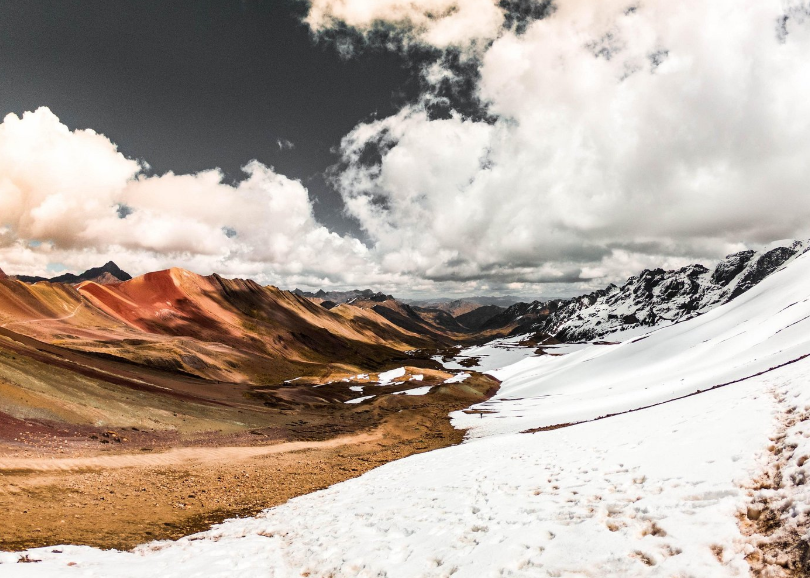
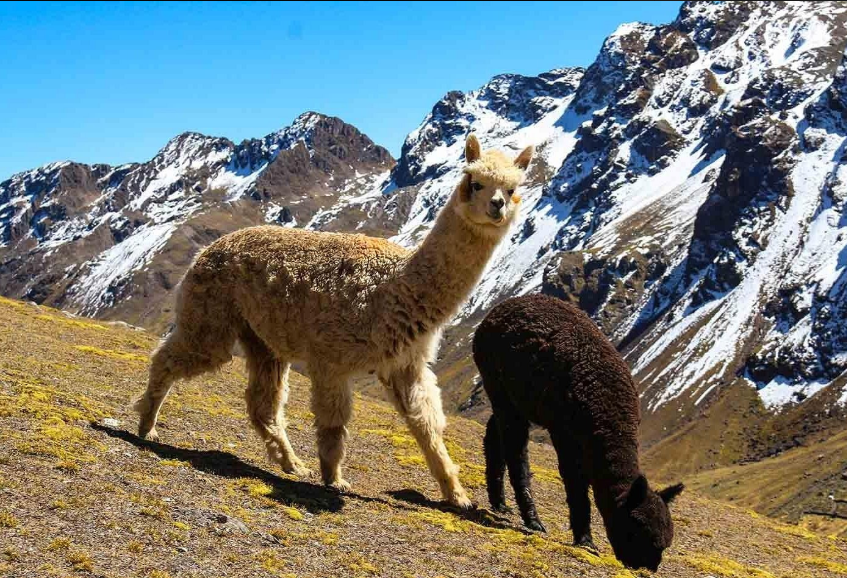
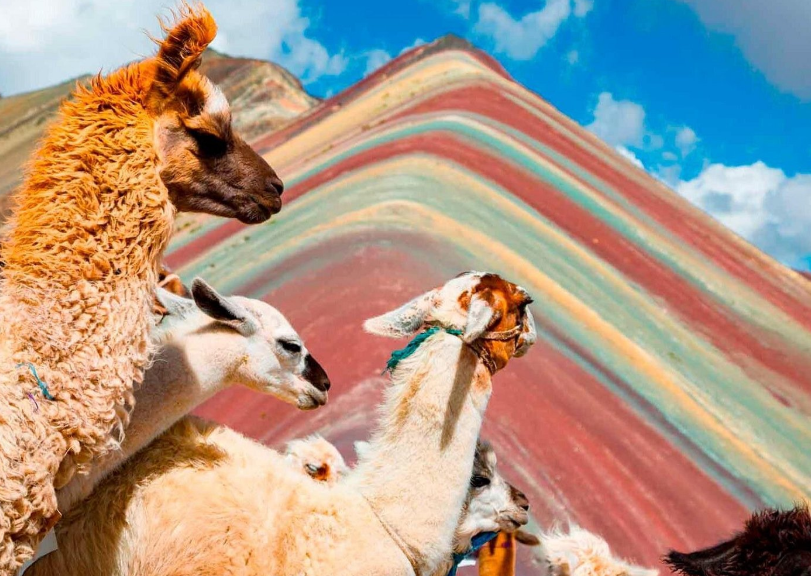
Around the mountain, the landscape is treeless, windswept, dotted with grazing alpacas and llamas you’ll absolutely take photos of (you can’t help yourself, they’re exactly as cute as you’re hoping). On a clear morning, you can see Ausangate in the distance, one of Peru’s tallest mountains, snow-capped and quiet, anchoring the whole horizon.
Most travellers reach Rainbow Mountain as a day trip from Cusco. There isn’t really another way to do it. I’ll get into why in a minute.
Why Rainbow Mountain Is So Colourful?
Our guide, somewhere around the middle of the ride up, took a moment to give us a geology lesson. He’d clearly given it many times before, but that didn’t make it feel rehearsed. He was the kind of guide who genuinely loved explaining his own country’s geology to a group of strangers from elsewhere, and it showed.
The colours, he said, are minerals. Real ones, not paint, not Photoshop, not the filter your guide says someone keeps asking him about. Each band on the mountain is a different mineral compound that oxidised over millions of years. The reds and rusts come from iron oxide. The yellows and golds are sulphur. The greens are copper sulphate. The whites are calcium carbonate. The purples come from manganese-rich clay.
The way the layers sit in stripes is the result of millions of years of sedimentation, with different minerals settling in different layers under prehistoric seas, followed by tectonic uplift that pushed the seabed thousands of metres into the air, then erosion that exposed the layers we see today. Walking up the slope, basically, is walking up an open-faced timeline of the Earth’s chemistry.
Then he told us something I hadn’t known going in. Vinicunca was buried under glacier ice until about ten years ago. Climate change melted the glacier, and the rainbow colours emerged. The Quechua communities had always known the mountain was there; they’d been crossing this valley for generations, herding their animals across slopes that had been frozen white for as long as anyone could remember. But as a tourist destination? It’s brand new. Every stall, every checkpoint, every set of stairs at the summit has been built since around 2015. He said this without bitterness, but with a kind of thoughtfulness, the same way you might talk about a thing in your life that’s both a gift and a complication.
He also said something I keep thinking about. Vinicunca isn’t the only rainbow mountain in the world. There are others in China, the Andes, and elsewhere with similar mineral colours and geological origins. What makes this one special, he said, isn’t that the colours are unique. It’s the elevation. It’s the air. It’s the fact that you have to work for it. You don’t drive up to Vinicunca, he said. You walk to her.
A practical note before we move on, because this part affects your trip planning, the colours are weather-dependent. You need sun and dry conditions for them to really pop. Overcast days mute everything. Snow can cover them entirely, even at this altitude during the dry season. The day before I visited, snow had reduced visibility to the point that travellers said part of the mountain was covered. We got lucky with a sunny morning. It’s worth knowing what you’re working with, and I’ll get into when to go later in this post.
Getting to Rainbow Mountain From Cusco
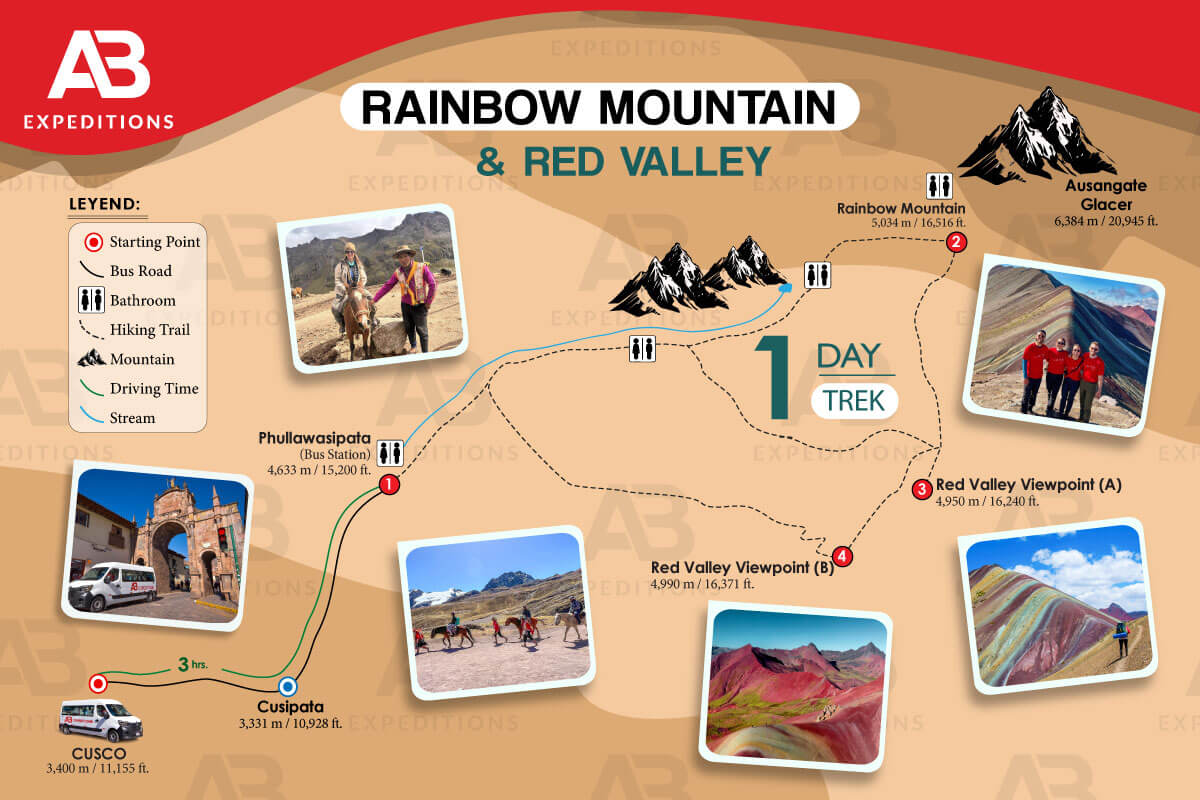
The honest answer is that you book a tour from Cusco. That’s how everyone does it, that’s how I did it, and I’d suggest it for one straightforward reason: there isn’t really a sensible alternative.
Public transport doesn’t run that far. A private taxi for a 12-hour day will cost you more than a tour. The trailhead itself is set up for tour groups, and you’d be navigating altitude and an unfamiliar route on your own without a guide who knows where the bathrooms are or who to contact if someone in your group goes down. Almost no one I spoke to did it independently.
Booking a guided tour
Tour pricing varies more than you’d think, and the difference between the cheap end and the mid-range is genuinely worth understanding before you book.
The cheaper tours run between $30 and $40 USD per person. They include hotel pickup, transport, breakfast, lunch, and a guide. Group sizes are usually big, 10 to 15 people on the bus. The guide usually speaks English and Spanish, but the logistics are solid. This is what I booked, through Viator, paying around $30 per person for two of us. The tour was great, and we were picked up directly at our Airbnb on Avenida Ciprés in Cusco. Breakfast was a hot meal at a roadside spot an hour into the drive, and the guide spoke enough English to give us the safety briefing, altitude advice, and the option to hire a horse at the trailhead.
The tours sometimes include the option for the Red Valley extension rather than adding it on at the trailhead. If you can swing the upgrade, it’s worth it. Having a guide who can pace the group around the slowest walker is genuinely valuable at altitude; you don’t want to be the slowest in a group of 18 fit Australians on their gap year.
A few things I’d check before you book a pickup location (some tours only collect from the Plaza de Armas, which means you walk / Uber over there in the dark at 3 am; confirm your tour picks up from your actual hotel), group size, and whether the Red Valley extension is included or added on at the trailhead. The Red Valley is genuinely worth seeing.
What time will you actually leave?
Pickup is between 3 and 4 am. Yes, really.
The early start is so you reach the summit while the morning light best highlights the colours, before the afternoon clouds roll in. By 1 pm, the mountain is often covered in clouds. By 2 pm, it can rain hard at times. Your tour is racing the weather, basically, and that 3 am wake-up is the price of arriving in time.
3 am in Cusco’s cold morning air can be rough, so be prepared. I packed my bag the night before. I went to bed early so I could get up early and get ready. I kept a thermos of hot water in the kitchen so I could throw a coca tea together fast on the way out the door.
What the drive is like?
The first hour of the drive gets you out of Cusco and into the Andean countryside, and most travellers sleep through it. I did. The bus was warm; our guide gave each of us a warm blanket; the city was dark; and there was nothing useful to look at until the sun came up.
The second hour climbs steadily through small farming villages, and by then the light is in. You’ll start seeing locals heading to fields with their animals, smoke rising from kitchens, the kind of slow, ordinary morning life you don’t see much of on the Cusco tourist circuit. I remember one village with kids walking around in traditional clothes, alpacas grazing on the verge between the road and someone’s house, women carrying things on their heads, like I’ve seen a bit of as a Caribbean girl.
The third hour is where it gets steep. The road turns unsealed, and you start climbing fast. Most tours stop somewhere along this stretch for a breakfast included in the price: eggs, bread, coca tea, and fruit, served at a roadside café set up specifically for the tour groups. It’s nothing fancy. But it’s hot, and you’ll be glad of it.
The bus will get cold as you climb. Bring a layer you can pull on without standing up. The altitude difference between Cusco and the trailhead is about 1,200 metres, and your body will start to notice: maybe a slight headache, maybe a flutter in your chest, maybe just a feeling that the air is thinner than it was when you left the city. That’s normal. That’s what’s supposed to happen. Stay hydrated, breathe slowly, and ride it out.
How Long Is the Hike?
Six kilometres, round trip. About 400 metres of elevation gain. On paper, that’s nothing. I’m Jamaican, I’ve done longer hikes than that for fun, in flip-flops, on a Saturday afternoon with friends.
On the mountain, at five thousand metres, six kilometres is a different conversation entirely.
Most travellers take 1.5 to 2 hours to reach the summit on foot, and 1 to 1.5 hours to come back down. If you take a horse, you’re looking at about thirty minutes up to the base of the final stair section, and then you walk the last bit regardless of how you got there. The horses can’t make it up the steepest part. Nobody can ride to the top. Whatever you choose, the final fifteen to twenty minutes of stairs is on your own legs, at the highest altitude, and that’s where most people find out what kind of climber they actually are.
So the timeline of the hiking part of your day shapes up something like this:
- Trailhead to summit on foot: 1.5–2 hours
- At the summit: 30–45 minutes for photos, the view, and catching your breath
- Summit back down to the trailhead: 1–1.5 hours
- Optional Red Valley extension: add about 45 mins
Total somewhere between 3 and 4.5 hours of moving on the trail, depending on your pace, your altitude tolerance, and whether you do the Red Valley.
Here’s a thing your guide may not say out loud, and I think it’s worth knowing. The tour is on a schedule, but it includes a buffer. Most tours give you about an hour and a half to climb up, an hour at the top, and an hour and a half to come back down. If you’re slow, you’ll still make the bus, but you might miss the time to actually enjoy the summit. The trick is to pace yourself early so you’ve got something left when you get there.
How hard is the hike?
It’s harder than the distance suggests.
The hike itself isn’t technical. There’s no scrambling, no rock climbing, no rope work. The trail is well-marked and well-trodden. There’ll be other tourists in front of you and behind you the whole way, and the path is clear enough that you couldn’t get lost if you tried. What makes Vinicunca hard isn’t the terrain. It’s the air.
At five thousand metres, you have roughly half the oxygen you’d have at sea level. Half. Your lungs work twice as hard for every step. Your heart rate spikes from walking thirty paces. Your ears start ringing if you push too hard, like the high-pitched tone after a loud concert, except it’s coming from inside your skull. (Mine did this several times on the way down. It’s not pleasant. It’s also not dangerous; usually, your body is just protesting the workload. Slow down, breathe, wait it out.)
That’s why a hike that would take a fit person 45 minutes at sea level takes most travellers 90 minutes here. Your fitness doesn’t disappear at altitude. It just stops translating the way it usually does.
If you’ve done the Inca Trail, Mount Kilimanjaro, or any of the bigger Himalayan treks, Vinicunca will feel manageable. If your benchmark is a flat 5K back home or a hill walk in your local park, this will feel hard. There’s no shame in that. Almost everyone struggles. The travellers I met who didn’t struggle were the ones who’d been at altitude for a week or more before they came.
Quick note for my Caribbean readers and especially my fellow Jamaicans. If you’ve climbed the Blue Mountain, you already know what your body feels like under a long, sustained climb. Vinicunca has a similar feel, but the part that struggles is your lungs, not your legs. The climb itself is shorter than the Blue Mountain. The air, though, is a different beast entirely. The good news is that if you’ve finished Blue Mountain, you have the persistence to finish this. The harder news is that there’s nothing that prepares your lungs for 5,200 metres except time at altitude. Arrive in Cusco at least 48 hours before your Vinicunca tour. Drink the coca tea. Take the tablets. (I’ll go deeper on altitude survival further down.) You’ll be fine. You’ll be more than fine.
The other piece of advice, and this one’s for everyone, is to know which version of yourself you’re trying to bring to this mountain. If you’re someone who needs to push through everything on your own steam, you’ll hike. If you’d rather have the memory than the workout, take a horse, take an ATV, take whatever your body and your wallet allow. There’s no honour in suffering up here. The mountain doesn’t care how you got to the top. The photos look the same either way. And whatever route you choose, the mountain is still going to ask something of you in those last fifteen minutes of stairs.
The Three Ways Up the Mountain
You’ve got three options for getting from the trailhead to the summit area: hiking, riding a horse, or taking an ATV (if your tour offers it, which most don’t). Each one trades cost for effort, and the right choice depends on your altitude tolerance, your fitness, and how much you want to feel the climb in your body the next morning.
A quick comparison before I get into the details:
| Hiking | Horse | ATV | |
| Cost (extra) | Free | 80–100 PEN | Time to submit |
| Time to the summit | 1.5–2 hrs | 30 mins (+ stairs) | 20 mins (+ stairs) |
| Effort | High | Low to moderate | Low |
| Best for | Hikers, fit travellers, those who want the workout | Most travellers — the smart middle option | Mobility issues, very limited time, those who didn’t acclimatise |
| Trade-off | Hardest at altitude | You still walk the final stair section | More expensive, less common |
A thing all three options share is that the final stair section to the actual summit is on foot, no exceptions. The mountainside above a certain point is too steep for horses or ATVs. Whichever option you choose, you’ve got fifteen to twenty minutes of stairs at the very end, at the highest altitude. Plan for it.
Hiking the trail
If you’re walking it, you start at the trailhead at around 4,600 metres. The path climbs steadily, not steeply at first, but the gradient sharpens in the second half. You’ll cross open grassland, pass small streams, walk under snow-capped peaks in the distance, and eventually reach the base of the final stair section.
Most fit travellers do the climb in about 90 minutes. Less fit travellers or anyone struggling with the altitude take closer to two hours. If you can walk uphill at a steady pace for an hour at home, you can do this. You’ll just go slowly.
The trick on foot is to pace yourself early. The slope feels easy for the first 20 minutes, and most people gas out trying to keep up with the fittest person in the group. Then the altitude catches them on the second half of the climb, and they’re done before the stairs even start. Walk slower than feels natural. Stop more than you think you need to. There’s no prize for getting to the top first.
Riding a horse
This is what I did, and I’d do it again.
The horses are owned by the local Quechua communities, and the handlers, usually young men or women from the surrounding villages, walk alongside leading the horse on a rope. You don’t ride the horse in the active sense. You sit on it. The handler does the work, walking the same uphill stretch you would have walked, just guiding the horse instead of carrying you herself. (I think about this often. The handlers walk that mountain every day, in the cold and the thin air, leading other people’s adventures. Tip them well.)
A few practical things about the horse option you’ll want to know going in:
It’s cash only. 80 to 100 PEN, paid directly to the handler at the trailhead, in Peruvian Soles. Have exact change. They don’t carry change.
You can’t pre-book. This is paid the day of, in person, at the trailhead. Your guide will walk you to the horses and connect you with a handler.
The horse takes you to the base of the final stairs, not all the way up. From there, you walk the last fifteen or twenty minutes regardless. Plan for that final climb to feel hard. It will.
Going down, you can also hire a horse for around 50 PEN if your legs are gone. (This is what I wish I’d done. The walk down was harder for me than the walk up. I’ll come back to this.)
The way I made the call to hire a horse was that I stepped off the bus, walked toward the horses, got about 50 metres, and realised I couldn’t breathe. That short walk told me everything I needed to know about what the full hike would do to me. I paid the handler at the trailhead, climbed onto the horse, and let her carry me up the mountain. It was the right call.
Taking an ATV
The ATV option is less common, more expensive, and not offered by every tour operator. You’ll usually need to book a separate tour specifically for the ATV experience. Some operators offer it as a half-day add-on to the standard tour. Others run it as its own thing.
The cost runs $40 to $80 USD per person, depending on the operator. You ride pillion behind a guide on a four-wheeler, on a marked off-road trail, to roughly the same drop-off point as the horses. From there, the same final stair section that everyone walks.
I didn’t do the ATV. But there was a Russian girl I met who’d done it the day before. She told me at breakfast, between bites of egg and bread, that the ATV had been her favourite. Less effort than hiking, less time than horseback, faster, easier on the lungs. If altitude scares you and you’ve got the budget, it’s worth considering.
If I went a third time, I’d take the ATV. Just to know what it feels like, and because I already know what hiking and horseback riding feel like.
Rainbow Mountain ATV tour from Cusco
Is Rainbow Mountain in Peru Worth It?
I’d tell anyone going to Cusco to do Vinicunca if they have a spare day, the budget, and at least 48 hours of acclimatisation already in the bank. The colours are stunning in person, even on a partly cloudy day, even when you’ve already seen them on Instagram a thousand times. The summit feeling is real. The story you’ll have at the end of the day is one of those I-climbed-a-mountain-in-Peru stories that actually stays with you, the kind that comes up at dinner parties for years afterwards.
But it isn’t for everyone, and I’d be doing you a disservice if I weren’t straight about that.
Who I’d say should go.
- Travellers who’ve already spent two or three days in Cusco and are reasonably acclimatised
- Travellers in good general health who can walk uphill at a steady pace
- Photographers, the colours are worth the early start, the cold, and the climb.
- Adventurers who want the highest-altitude story of their Peru trip
- Slow travellers building toward Machu Picchu, Vinicunca is harder, so doing it first calibrates your sense of what your body can handle at altitude.
Who I’d say should think twice.
- Travellers with heart conditions, severe asthma, or pregnancy, talk to your doctor first, and if your doctor says no, listen. There’s no helicopter rescue at 5,200 metres.
- Travellers who’ve been in Cusco for less than 48 hours. Acclimatise first. The mountain isn’t going anywhere.
- Travellers with bad knees or hips, the descent is hard on joints, and the horse can carry you up but not down without an extra fee.
- Travellers who don’t enjoy crowds. I’ll come back to this in a moment, because it’s worth knowing what you’re walking into.
A note on the crowds
Rainbow Mountain is famous, which means it is busy. There are stalls at the trailhead selling souvenirs and snacks. There are queues at the iconic photo spots. There are dozens of buses pulling into the parking area at the same time as yours, all of them disgorging tourists who are about to do the exact same hike you’re about to do.
If you’re someone who wants a quiet, untouched, off-the-beaten-path mountain experience, Vinicunca isn’t really that anymore. It hasn’t been since around 2018, when Instagram caught on to the colours and visitor numbers started climbing fast.
The trick, and I do mean trick, is to step a little aside from where everyone else is taking the same photo. Your guide will point out the iconic spots, and the views from them are gorgeous. But the view from ten metres to the left, where there’s no queue, is also gorgeous. (I got my best photos from there.) Go where the crowds aren’t. The mountain will give you space to actually feel it if you let yourself off the photo line for a few minutes.
Best Time to Visit Rainbow Mountain
The short answer is May to September, the dry season, specifically June, July, and August, which are the most reliable months.
The dry season runs from May to September. Cool sunny days. Cold mornings and nights. Reliable weather, mostly. The colours are most vivid in dry conditions and full sunlight, so this is when Vinicunca shows up best for the camera. It’s also peak tourist season for exactly that reason, but the weather is worth the crowds.
The wet season runs from November to March. Rain, fog, occasional snow, even at this altitude. Mornings can still be clear (most of the rain comes in the afternoon), which is part of why the tour pickups are so early; they’re trying to get you to the summit before the weather turns. But the weather in the wet season is unpredictable, tour cancellations happen, and the colours look softer because the moisture in the air mutes them. The crowds are smaller, prices are lower, and on a good day, the wet-season colours have a richness to them that the dry-season clarity doesn’t quite match.
Shoulder seasons, April and October, are a roll of the dice. It could be perfect. It could be disappointing. Costs are cheaper, crowds are thinner, and the weather is anyone’s guess.
I went in March, which is the absolute tail end of the wet season, and I had a beautiful day. The day before I went, snow had reduced visibility so much that the travellers I met said the mountain was lightly covered. I got lucky. If I were planning my next trip, I’d go in June or July without thinking twice; the colours, the weather, and the longer daylight hours all line up.
A practical thing to consider when you go, if you’re already in Cusco: check the weather forecast the day before your booking. Most tours offer flexible rescheduling within reason. If tomorrow looks like it’s going to be a soaking day, push it back a day. The colours are worth waiting for.
Surviving the Altitude on Rainbow Mountain
The altitude is the hardest part of this trip, harder than the climb itself, harder than the cold, harder than the early start. I’m going to give you the survival kit here in shorthand and link to a deeper post on managing altitude across Peru when that one’s live.
What worked for me was a combination of things I picked up from a friend in Cusco who’d been there for years, from our guide on the way down, and from the strangers I shared a bus seat with on the trip home. Take what feels useful.
Acclimatise in Cusco for at least 48 hours before your tour.
This is the one piece of advice I’d hold to. Cusco sits at 3,400 metres. Vinicunca’s summit sits at 5,200. Your body needs time to make the red blood cells that make the difference manageable. Two days walking the city slowly, drinking coca tea, sleeping well, that does most of the work for you.
Take altitude sickness tablets the moment you land in Cusco.
Not after you start feeling symptoms before. By the time you feel altitude sickness coming on, you’re already behind it. A friend of mine who lives in Cusco met us at the airport, holding tablets. Most travellers I met had picked theirs up at a pharmacy in Lima before flying up, or at a pharmacy in Cusco on day one.
Drink coca tea like it’s water. Coca tea mate de coca is offered free at almost every restaurant, café, hotel, and Airbnb in Cusco. It’s grassy, slightly bitter, and worth drinking with every meal. (One thing worth knowing is that you can drink coca tea while you’re in Peru, but you can’t legally take coca leaves out of the country. Customs will confiscate them. Enjoy it while you’re there.)
Carry Agua Florida, a small bottle of rubbing alcohol, and a piece of cotton in a ziploc bag. This is the single best altitude trick a friend in Cusco gave me. Agua Florida is a Peruvian flower-essence water you can buy for a few PEN at any pharmacy. You mix it with a little rubbing alcohol on a cotton pad, seal it in a small ziploc bag, and keep it in your pocket. When your heart starts racing, or your ears start ringing, you pull it out, hold the cotton close to your nose, and breathe deeply. The clarity that comes back is real, and it’s fast.
Learn the breathing technique. On my Scared Valley Tour, my guide taught me a breathing technique that really helped. Breathe in slowly through your nose. Hold the breath for longer than feels natural. Then exhale slowly through your mouth. The pause is what matters; that’s what gives your lungs time to actually transfer oxygen into your bloodstream. The instinct at altitude is to gulp air, fast and shallow, the way you’d breathe after running for a bus. That doesn’t work up here. Slow and deep does. He stayed with me on the way down, walking the slow walk while I breathed the slow breath, and somewhere around the halfway point, I felt it start to work. I was still slow. I was still tired. But I could walk again.
Bring coca leaf sweets with you. They’re sold everywhere in Cusco for a few PEN per pack. Suck on one when you feel altitude pressing in. The sweets carried me through the harder stretches more than the tea did, honestly.
Drink water more than you feel thirsty. Eat lighter than you would at home. Avoid alcohol the day before. Sleep early the night before. None of this is glamorous. All of it helps.
If your guide offers oxygen, take it. There’s no medal for refusing oxygen on Vinicunca. I didn’t need it. Several travellers on the trail with me did, and they were fine.
What Rainbow Mountain Peru Actually Costs
The whole trip tour, entry, horse, snacks, and the works run around $80 to $120 USD per person for most travellers. That’s the comfortable-budget version, where you’ve booked a decent tour, paid for a horse if you want one, added the Red Valley, and brought enough cash for bathrooms and tips along the way.
Here’s how the costs broke down for me:
| Cost Item | Approximate Price (USD) |
| Standard tour from Cusco (booked via Viator) | $30–$40 |
| Mid-range tour with smaller group + Red Valley included | $50–$80 |
| Trail entrance fee (paid at trailhead, in PEN) | $8 |
| Horse up the mountain (80–100 PEN, cash) | $22–$28 |
| Horse down the mountain (50 PEN, optional) | $14 |
| Bathrooms along the trail (2 PEN per use) | $1–$2 |
| Snacks, water, gloves, hat (if buying en route) | $5–$10 |
| Red Valley extension (if not included) | $5–$15 |
| Total per person, comfortable budget | $80–$120 USD |
A few things worth knowing before you start budgeting.
The tour is paid in advance, usually online when you book through Viator or directly with the operator. But everything else on this list is paid for in cash, in Peruvian Soles, at the trailhead. There’s no ATM at Vinicunca. Whatever cash you arrive with is what you have for the day. Pick it up before your tour day in Cusco.
The horse-handler payment caught me out, and I want to flag it specifically. The handlers carry no change. None. If the price is 80 PEN and you give them 100, you’ve just paid 100. Have exact change ready. (Honestly, after watching them walk uphill at 4,800 metres for hours, leading other people’s adventures, I think 100 is fair. Tip them well if you can.)
Most tours include breakfast and lunch. Confirm before you book, because the cheaper end occasionally doesn’t, and you’d be paying 20 to 30 PEN at the trailhead café for a meal that should have been included in your fare.
Tipping the guide is expected at the end of the tour. Around 10-20 PEN per person is standard. Most guides will not mention it, gently, near the end of the day, usually when they’re saying their goodbyes outside your hotel. Bring a 20 PEN note specifically for this so you’re not fumbling at the curb.
If you’re travelling on a tight budget, yes, you can do Vinicunca for around $50-$60 per person. Cheapest tour, walk the whole thing, skip the Red Valley, bring your own snacks. I’d genuinely recommend not doing that. The horse is worth it. The Red Valley is worth it. The mid-range tour with a smaller group is worth it. This is a trip you’ll probably do once. Don’t skimp on the wrong things.
What to Pack for Rainbow Mountain
The conditions on Vinicunca can range from intense midday sun, possible afternoon rain or snow, and high-altitude air that dries you out faster than you’d think possible. Packing right is genuinely the difference between a great day and a miserable one.
Here’s what I’d actually pack.
The essentials
Layered clothing. The mountain goes from below freezing at dawn to mid-twenties Celsius by midday and back to cold again before you’re back at the bus. A base layer (thermal top and leggings), a fleece or thick mid-layer, and a windproof waterproof jacket on top. Bring gloves and a hat. The wind at altitude is something, so I bought a pair of cheap thermal gloves in Cusco’s Mercado Artesanal for 15 PEN, and they saved my hands on the descent.
A rain poncho or waterproof shell. Even in the dry season. The weather can turn at this altitude in twenty minutes flat, and being caught in cold rain when you’re already exhausted is the kind of small thing that ruins a big day.
Sturdy hiking shoes or boots. Closed-toe, with grip. I wore trail runners; they were fine, but don’t wear new shoes. Break them in first. Blisters at 5,000 metres are not the souvenir you want.
Trekking poles. Optional, but I’d honestly suggest them, especially for the descent. Going down is harder on the knees than you’d expect, and at altitude, anything that takes load off your legs is welcome.
Get a collapsible trekking pole
Sunglasses. UV at altitude is no joke. Even on overcast days, your eyes burn fast. Polarised lenses, if you have them.
Get a pair of polarised sunglasses
Sunscreen, SPF 50. I was warned about the altitude sun, and I still got burned. The air is thinner, the UV is stronger, and you’re closer to the sun than your skin has ever been. Apply before you leave Cusco. Reapply at the trailhead.
Cash in small Peruvian Soles. For the horse, the entrance fee, the bathrooms, snacks, and the guide tip. Bring 200 PEN at a minimum.
Water at least 1.5 litres. Most tours give you bottled water at breakfast and lunch, but you’ll want your own on the trail. Altitude air dehydrates you faster than the heat back home does.
Coca leaf sweets and the Agua Florida cotton. As I covered in the altitude section above. Your friends.
The nice-to-haves
A power bank. You’ll take more photos than you mean to. Cold weather drains phone batteries faster than usual, and the last thing you want is a dead phone at the summit. I brought a small slim one and used it twice over the day.
Get A Portable slim power bank
A global data SIM or eSIM. I use a global data SIM that works seamlessly across South America, no fumbling for local cards, no roaming charges, and consistent service across borders. For a trip like this, where you’re moving between countries or just want WhatsApp to work without panic, it’s worth it.
A small dry bag or Ziploc bag for your phone, in case it rains. Phones don’t love getting soaked, especially in cold weather, where the temperature shock can mess with the battery.
A buff or scarf. Useful as wind protection on your neck and face. Doubles as a way to cover your nose if the cold, dry air starts irritating your lungs, which it can, especially on the descent.
The skip list
A heavy day pack, you don’t need a 30-litre pack for this trip. Anything over 10 to 15 litres is overkill, and the extra weight slows you down at altitude in ways that aren’t worth it.
The hiking sticks that the trailhead vendors sell for 5 to 10 PEN. They’re fine. They’re also flimsy. If you want poles, bring proper ones from home.
Cotton clothing is a base layer. Cotton holds sweat, gets cold, and stays cold. Synthetic or merino base layers only.
Heavy boots unless you’re already used to hiking in them. New heavy boots will be more punishment than help. Trail runners or light hiking shoes work for almost everyone.
Should You Add the Red Valley?
Yes. Almost always yes.
The Red Valley is an added 10-20 minutes from Vinicunca’s main viewpoint, along a trail that branches off from the summit area. The valley itself is a sweep of deep-red mountainside, the same iron oxide that gives Vinicunca its red stripes, spread across an entire wall rather than a single peak. It’s gorgeous. It’s less crowded than the main mountain. It feels more like the Andes used to be before the buses started arriving.
A few practical things about the Red Valley.
It’s an extension, not part of the standard tour. Most tours offer it as an add-on for an extra 30 PEN Soles per person, paid at the trailhead. Some mid-range tours include it by default. Check before you book.
It adds about 45 minutes to the day. The walk from Vinicunca’s viewpoint to the Red Valley is mostly flat or gently downhill, making it easy after the climb to the summit. The walk back, though, is uphill. At 5,000 metres, that’s its own kind of challenge. Your legs will feel the difference.
Not everyone in your group will go. When the guide offers the extension, only some travellers will say yes. If you’re hesitating because your altitude tolerance is borderline or you’re already tired, it’s okay to skip. If you’ve still got energy at the summit, do it.
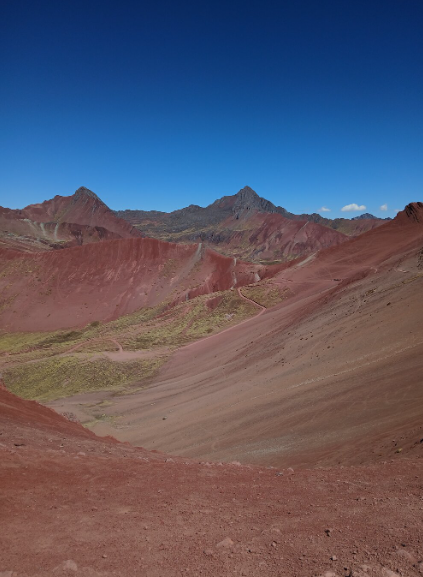
I went. I’m glad I went. The Red Valley was honestly my favourite part of the day, quieter, stranger, more cinematic than the main mountain. Fewer people. More space. Deeper colours. If you have any energy left after Vinicunca, walk the extra mile. You won’t regret it.
The Red Valley was honestly my favourite part of the day quieter, stranger, more cinematic than the main mountain.
Is Rainbow Mountain Safe?
The trail itself is well-maintained and well-marked. There are no sketchy drop-offs, no exposed scrambles, no real risk of getting lost on a guided tour. Tour operators carry oxygen and basic first-aid supplies and maintain radio contact with each other. The Quechua communities that manage the trailhead have extensive experience helping travellers in distress, and the road back to Cusco is open all day.
The genuine risks are altitude-related, and they’re worth being clear-eyed about.
Altitude sickness can hit anyone. Fitness doesn’t protect you. Age doesn’t protect you. The travellers I saw struggle hardest on my trip were often the younger and fitter ones, the kind of people who assumed their gym routine would translate, only to be surprised when it didn’t. The way to manage altitude sickness isn’t to prevent it (you can’t, really). It’s to recognise it and respond. Severe headache, nausea, dizziness, vomiting, confusion, or shortness of breath at rest? If any of these come on, tell your guide right away. Don’t try to push through.
Heart conditions and pregnancy are genuine red flags. The thinner air at this altitude puts real strain on the heart and circulatory system. If you’ve got a heart condition or you’re pregnant, talk to your doctor before booking, and if the answer is no, listen.
Asthma can flare up unexpectedly. Bring your inhaler. Even if you haven’t used it in years.
The reassuring news is that tens of thousands of travellers take this trip every year, and the overwhelming majority finish without incident. Be sensible. Acclimatise. Listen to your body. Take the oxygen if it’s offered. You’ll be fine.
Frequently Asked Questions
How far is Rainbow Mountain from Cusco?
About 100 kilometres south-east, in the Cordillera de Vilcanota mountain range. The drive takes around three hours each way on mountain roads, the last hour of which is unsealed.
How long does it take to get to Rainbow Mountain from Cusco?
Three hours by road, one way. Most tours pick up from Cusco hotels between 3 and 4 am and return around 5 pm. A full 12-hour day door to door.
Can you do Rainbow Mountain in one day?
Yes, and that’s how almost everyone does it. There’s no overnight option. The trip is structured as a single long day from Cusco.
Is Rainbow Mountain in Peru natural?
Yes. The colours are real, formed by mineral deposits of iron oxide, copper sulphate, sulphur, calcium carbonate, and manganese that oxidised in layers over millions of years. The mountain was buried under glacial ice until around 2015, when climate change melted it, revealing the colours we see today.
When was Rainbow Mountain discovered?
By tourists, around 2015, when the glacier covering it had melted enough for the colours to become visible. The local Quechua communities had known about the mountain for generations, but it wasn’t on the tourist radar until photos started circulating online.
How was Rainbow Mountain formed?
Over millions of years of sedimentation in prehistoric seas, various minerals settled in distinct layers. Tectonic uplift then pushed the seabed thousands of metres into the air, and erosion exposed the layers we see today. The result is a striped mountainside that reads almost like a geological timeline written into the rock.
Are Rainbow Mountain’s colours real?
Yes. Not paint, not filters, not Photoshop. Mineral oxidation in the rock itself. Photos do enhance saturation; the colours look more vivid in dry weather and full sunlight, less so on overcast days, but the colours themselves are absolutely real.
Do you need a guide for Rainbow Mountain?
Practically, yes. There’s no legal requirement for a guide, but the trailhead is set up for tour groups, the road is unsealed and difficult to navigate independently, and altitude emergencies need someone with oxygen and radio contact. Almost every visitor goes on a tour.
What time do Rainbow Mountain tours start?
Pickup from Cusco hotels is usually between 3 and 4 am. The early start is so you reach the summit before the afternoon clouds roll in. The mountain often clouds over by 1 pm, and rain is common after 2 pm.
Is altitude sickness on Rainbow Mountain common?
Yes. At 5,200 metres, most travellers experience symptoms such as headache, breathlessness, and fatigue. Severe altitude sickness is less common but real, especially for travellers who haven’t acclimatised in Cusco for at least 48 hours. Bring tablets, drink coca tea, and tell your guide if you feel unwell.
Can you do Rainbow Mountain without hiking?
Sort of. You can ride a horse for most of the climb (80–100 PEN, paid in cash to local handlers) or take an ATV with a separate operator. Both options take you to the base of the final stair section, which everyone walks regardless. There’s no way to skip those last fifteen to twenty minutes on foot.
What’s better, Rainbow Mountain or Machu Picchu?
They’re different. Machu Picchu is an Inca citadel with deep historical and cultural weight. Rainbow Mountain is a natural geological wonder. Most travellers do both, and most who do tell me Vinicunca is harder physically (because of the altitude), but Machu Picchu hits deeper emotionally. If you only have time for one, Machu Picchu is the headline. If you have time for both, do Vinicunca first. It’ll calibrate your sense of what your body can handle at altitude.
A Final Thought
Here’s the thing nobody told me about Vinicunca.
It isn’t really about the colours. The colours are stunning, yes. They’re worth the photos and worth the early start. But that’s not what stays with you afterwards.
What stays with you is what your body does to get there. The breath you have to fight for. The slow, deliberate steps in the last stretch of stairs, when your lungs are working harder than they’ve ever worked and your heart is doing something it doesn’t usually do. The shaman is a guide teaching you how to breathe on the way down, walking the slow walk with you while you breathe the slow breath. And the bus ride home, that’s the part I keep coming back to.
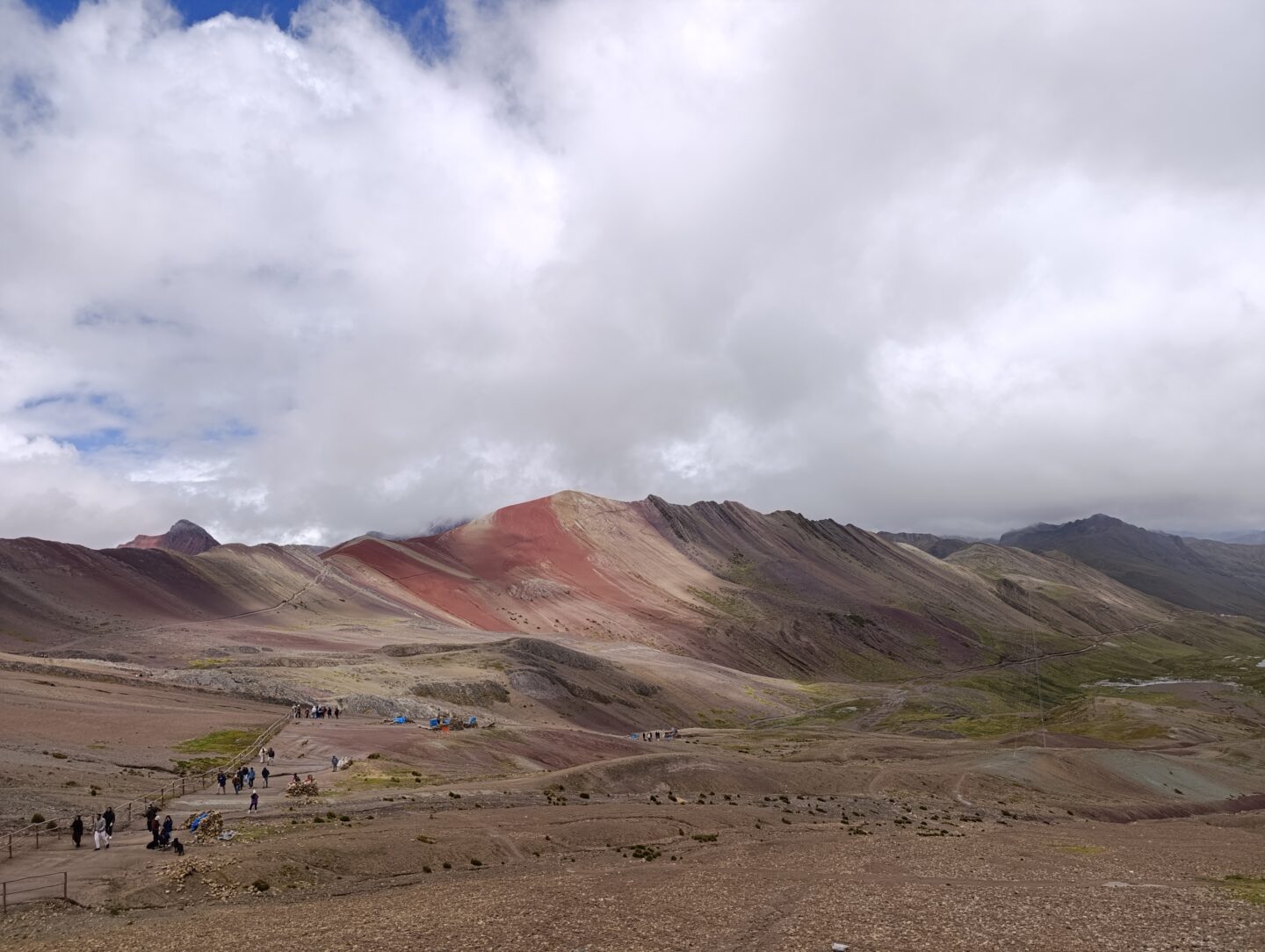
On the way back to Cusco, that bus was full of people who’d just done a hard thing. Strangers who’d shared the same eight hours, who’d all stood at the same summit, who all came down with the same headache. People started passing painkillers down the rows. Someone had paracetamol. Someone had ibuprofen. Someone had a bottle of water they’d barely touched. We weren’t a group when we got onto that bus at four in the morning. We were a group on the way home, people who’d needed help getting through, who knew exactly what the others had just been through, who didn’t need to explain anything.
There’s a kind of life-lesson tucked inside that climb. The same posture you find yourself in on the mountain, your heart racing, your ears ringing, the end nowhere in sight, the question of why am I doing this in the first place, that’s the same posture as so many other things in life that feel impossibly hard. Persisting through the hard middle. Getting to the top. Coming back down on legs that surprised you. Knowing, afterwards, that you can do hard things.
If you’ve ever wondered whether you can do something difficult on your own, at altitude, in a country where you don’t quite speak the language, yes. You can. Vinicunca is just one of the things you’ll do.
Take the horse if your body asks for it. Walk down if your spirit needs to know it can. Bring the Agua Florida, the breathing technique, and the cash in small PEN Soles. Acclimatise properly. Listen to your guide. Tip the horse handler well; those are people walking the mountain every day, in the cold and thin air, leading other people’s adventures.
And when you’re standing at the summit, with the rainbow stripes behind you and your breath coming back, know this. The mountain didn’t break you. It challenged you. There’s a difference, and it’s the whole post.
Live deeper, travel slower.
Check Out These Links
Tarjeta Andina de Migración (TAM) Virtual
Llaqta Machupicchu
Inca Rail
What to know before visiting Peru
The 10-Day Peru Itinerary (Lima, Cusco & Machu Picchu)
How to Do Machu Picchu Peru
The Complete Guide to Miraflores, Lima
Things to Do in Lima That Aren’t Just Touristy
Huacachina & Paracas: A Day Trip From Lima
Are You Planning Your Next Trip? Here’s What I Use
These are the tools I rely on to make every trip smoother, safer, and more meaningful. If you use the links below, I may earn a small commission at no extra cost to you. Thank you for supporting this blog and my journey as a full-time traveller 💜
1. Learn the Local Language
I use Babbel to practice Spanish, French, and Portuguese while travelling. The app makes it so easy to learn useful phrases on the go.
2. Travel Insurance is a Must
I never leave home without SafetyWing. They’re affordable and ideal for frequent travellers or digital nomads.
3. Book Your Tours & Experiences
For unique local tours and must-see experiences, I use:
→ Viator
→ Get Your Guide
4. Always Stay Connected
No matter where I go, Keepgo helps me stay connected with international data SIMs and eSIMs that actually work. A lifesaver when Wi-Fi fails!
5. Organise Your Itinerary
I use Tripsy to plan and store my itineraries, documents, and bookings in one clean app. It’s perfect for keeping track of everything in one place.
Until next time, travel softly,
Destiny 💜

Exploring the globe, one cultural story at a time. Dive into immersive travel experiences, historical discoveries, and authentic connections with local communities. Join the journey where every place has a story.
